One sky, many truths
Space Situational Awareness — why it needs an open federation, not another hub.
In March 2020, at Libre Space Foundation, we published Space Situational Awareness — The story so far and an open way forward. We surveyed who tracks objects in orbit, showed how little of that data is open, and set out four principles: open data, a modern open-source stack, verifiability, and open participation. We also pictured SatNOGS DB as a hub where open SSA data could gather.
Six years later, the principles still hold. The idea of one hub, even an open one, is the part we have rethought. There are far more satellites, sensors and catalogues than in 2020, and still no shared picture of what is up there. The reason is structural: there is no single source of truth in SSA, and there never will be.
So this essay proposes something else. Open-source software that anyone can run as their own SSA node, and an open protocol that lets those nodes exchange exactly what each of them chooses, with whom they choose. A federation, with no one at the centre.
There is no single source of truth
A space object catalogue is not a list of facts. It is a set of estimates, each one the output of a model fed with the measurements its owner happens to have.
Every catalogue makes its own choices: which sensors to trust, which force models to run, which detection belongs to which object, and when an unknown detection becomes a new object. Two competent catalogues will disagree on positions and on uncertainties. After a rideshare launch of dozens of small satellites, they can disagree for weeks on which object is which.
That disagreement is not a defect to be voted away. It is information: where catalogues diverge is exactly where the uncertainty lies, and where one more measurement is worth the most. A system that hides it behind one “authoritative” answer throws that information away.
The authoritative catalogue also assumes an owner that everyone trusts and that sees everything. No such owner exists. Each state, agency and company sees part of the sky, through its own sensors and its own interests.
Everyone filters, and for reasons
Our 2020 essay asked for all SSA data to be open. That is still where we want to end up. But SSA data does not flow freely today, and wishing will not change why.
What goes out is filtered:
- States withhold their own and their allies’ sensitive objects, or release them late or degraded.
- Companies sell tracking data. It is their business.
- Satellite operators share ephemerides with each other, as members of the Space Data Association do, but not with the world.
- Observatories and universities often publish only once their analysis is done.
What comes in is filtered too. No serious operator feeds unknown data straight into a manoeuvre decision. They weigh each source by its record, keep track of where every number came from, and sometimes refuse a source outright, for legal or political reasons.
These are not failures of goodwill. They are the conditions under which SSA is done. A system that works only when everyone opens everything works for nobody today. A system that makes openness the easiest choice, and every restriction an explicit, visible rule, can work for everyone now, and move them towards openness over time.
Hubs and handshakes do not scale
Today, SSA data moves in one of two ways.
The first is the hub. One operator collects, decides and distributes, under one policy and one licence: Space-Track, the EU SST service portal, a commercial platform. Users take what is offered on those terms, or go without. Data flows out of the hub; very little flows back in. The EU SST partnership pools the sensors of its member states, which makes it a federation of a kind, but a closed one, with fixed members and a single policy.
The second is the handshake: one bilateral agreement at a time. The United States has built a long list of SSA sharing agreements with states, agencies and companies. Each takes lawyers, months of negotiation and a custom data arrangement. Fifty parties make 1,225 possible pairs, and nobody can negotiate them all.
Both models leave the same gap. Measurements that could confirm an identification or avoid a collision exist somewhere, but they do not reach the people who need them in time. What is missing is the layer in between: a common, open way for any two parties to connect, under rules each of them writes.
An open federation of SSA nodes
We propose to build that missing layer in the open, in two parts.
- Node software. An open-source SSA system that anyone can run: a space agency, a satellite operator, a university observatory, an amateur tracking group. It ingests measurements, determines orbits, keeps its own catalogue and screens for conjunctions. Each node carries its owner’s name and its owner’s rules, not ours.
- A federation protocol. An open specification for how two nodes connect and what flows between them. We call each connection a peering. A peering states what goes in each direction, at what level of detail and on what terms.
There is no centre. No node is special, including ours. What the members share is the code and the protocol, not a server.
This is how the Internet already works. Tens of thousands of independently run networks exchange routes through peerings, each with its own import and export policy, and there is no central routing authority. Email and the Fediverse work the same way. SSA can too.
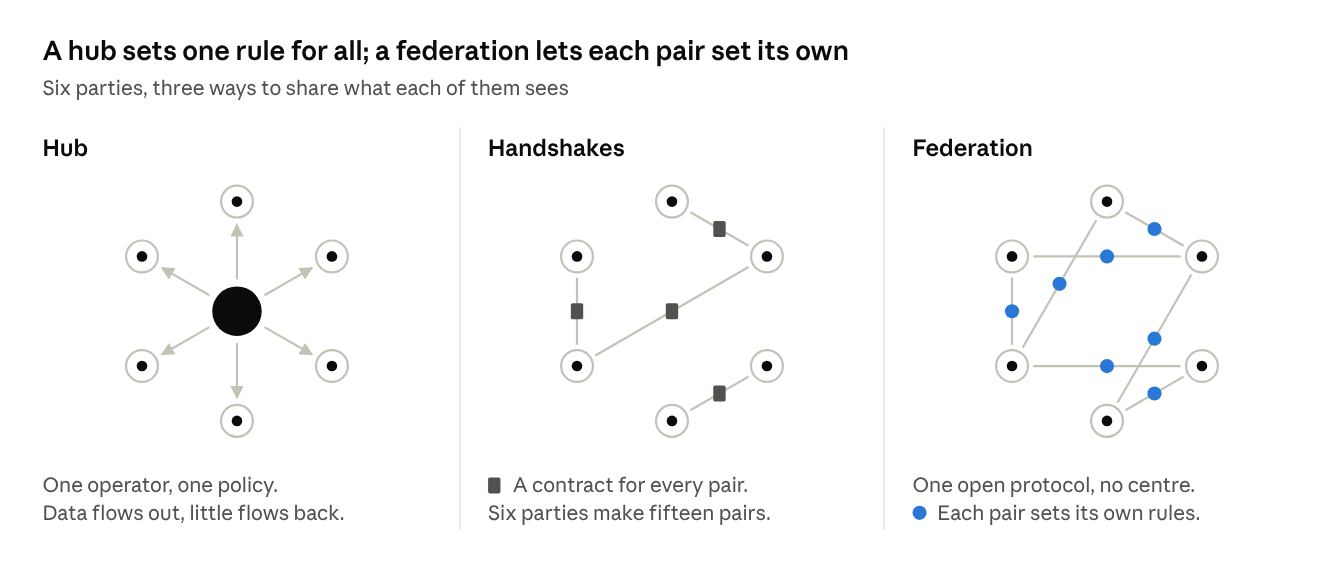 A hub sets one policy for everyone, and handshakes need a contract for every pair. A federation needs one open protocol, and each pair sets its own rules.
What flows between nodes, and on whose terms
Nodes speak the standards the field already uses. Measurements travel as CCSDS Tracking Data Messages, orbits as Orbit Data Messages, close approaches as Conjunction Data Messages, and re-entry predictions as Re-entry Data Messages. No new formats, and no lock-in.
Each peering carries its own policy, set separately for each direction: which kinds of data flow, about which objects and from which sensors, how soon, in how much detail, and whether the peer may pass them on.
Four rules hold for every peering. Provenance travels with the data: every message is signed by the node that produced it, and data from a peer enters the receiving node as a separate source with its own weight, never silently merged. Trust is earned rather than declared: a node can score each peer’s orbits against later measurements and adjust its weight, so trust becomes a measured track record.
Disagreement stays visible. When two sources disagree about an object, the node keeps both, shows the difference, and can ask for another measurement. Identity, finally, is worked out together: a newly detected object gets a local identifier first, and nodes cross-reference their identifiers as the identification firms up.
Open data is a first-class peering, not an afterthought. Any node can publish any class of data to everyone, under an open licence, with one setting. Ours will.
Why it must be open and neutral, and why us
The plumbing of a federation must belong to no one. If one state builds it, its rivals will not connect. If a vendor builds it, it becomes a product, and every competitor stays out. Only an open specification and copyleft open-source code, governed in the open, can be trusted by parties that do not trust each other.
Libre Space Foundation is in an unusual position to start it. We sell no data and hold no national security mandate. We built SatNOGS, a global network of ground stations owned and run by others, whose data is open to everyone; in practice it already works much like a federation. And we have kept working on open SSA since the 2020 essay: identifying satellites after launch, determining orbits from Doppler measurements, and tracking objects optically.
Others could build parts of this. Few have a reason to build all of it and give it away. We do, because that is what we exist for.
What comes next
We are starting with three things:
- A first draft of the federation protocol, published for open comment.
- Node software released under an open-source licence, built on the components we already run.
- A first peering between two independently operated nodes, exchanging real measurements.
We want people to break it early: space agencies and national SST centres, satellite operators, observatories and universities, amateur trackers, and commercial providers who would rather connect than stay a silo. Read the draft, run a node, and tell us what your policy would need to say.
Stay tuned.
Per liberum, ad astra.